
Crack sealing
Shrinkage and hairline cracks that are not moving are usually cleaned and filled with an epoxy or polyurethane material. Sealing does not stop settlement.
Cracked tile, sticking doors or a slab edge losing soil? Here is why slabs settle on Central Florida sand and fill, how repairs are chosen, and how to compare free quotes.
Get a Free Quote Call (727) 300-6656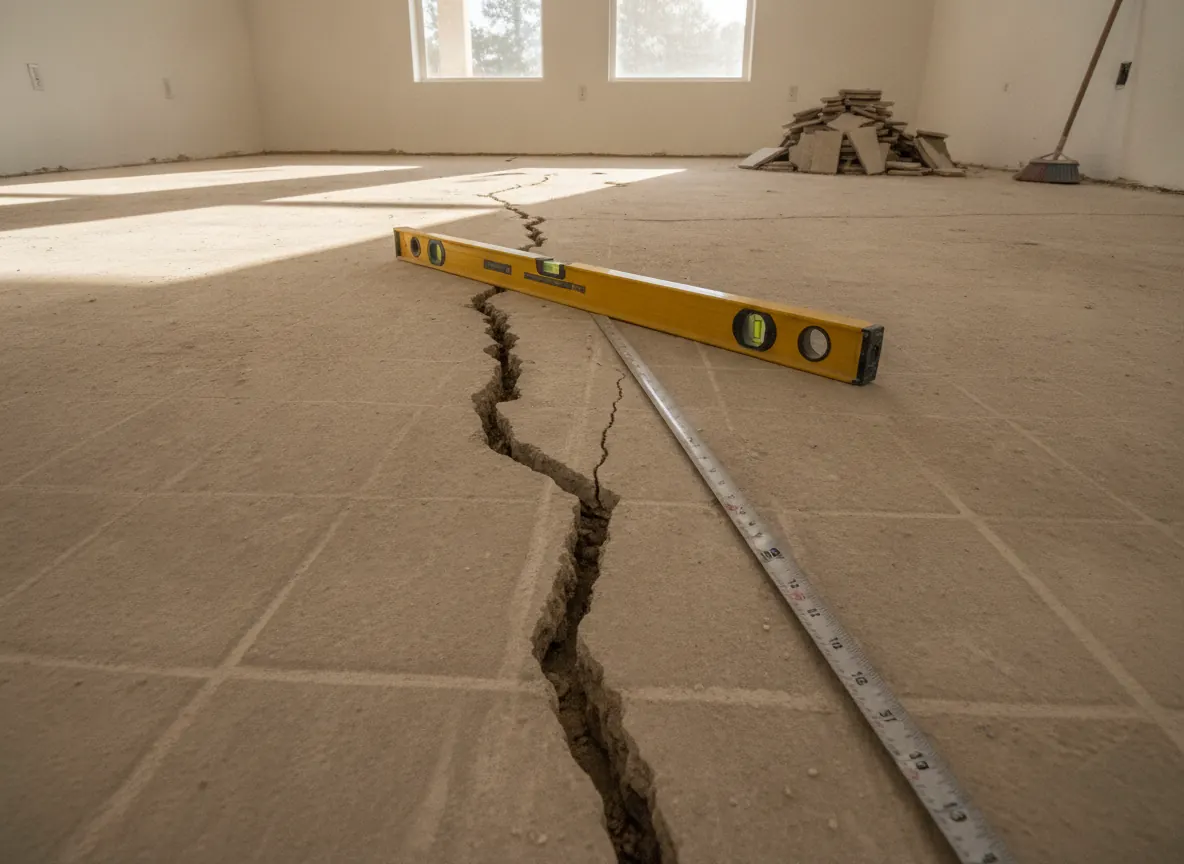
Most Central Florida homes sit on concrete slabs poured directly on the ground, so when the soil under a slab moves, the slab, the walls and the floor finishes move with it. What makes this region different is the soil itself. USDA NRCS soil survey data shows that Orlando-area soils are mostly sands with negligible shrink-swell: the common series are Smyrna, Candler, Tavares, Myakka and Basinger, and Candler sand carries only about 1–1.4 percent clay with a linear extensibility (shrink-swell) rating of 0. The "expansive clay" story told elsewhere does not fit most Orlando slabs.
Settlement here is usually about compression and loss of support instead: organic soils (muck) that compress as they lose water, fill that was poorly compacted when a lot was built up, sand washed out from under the slab edge, and, less often, raveling of sand into voids in the limestone below. Organic soils such as Samsula muck cover roughly 6 to 7 percent of Orange, Seminole and Osceola and about 13 percent of Lake (NRCS SSURGO). These are county-wide figures, not a map of any street.
A pattern of several signs, or change over a few months, matters more than any one.
Florida Geological Survey (FGS) records include a 2025 report from an Orlando homeowner describing a "crack in the interior walls of his home, the windows are stuck, and the door frames are having issues." It is a single unverified report. Many of these signs also have other causes, from concrete shrinkage to plumbing leaks, so diagnosis comes first.
The repair depends on why the slab moved, how far, and whether movement has stopped.
Shrinkage and hairline cracks that are not moving are usually cleaned and filled with an epoxy or polyurethane material. Sealing does not stop settlement.
Where a slab section has dropped, contractors drill small holes and inject expanding polyurethane foam (or a cement slurry, called slabjacking or mudjacking) to fill voids and raise the concrete. It works when the soil below has stopped moving.
When the bearing soil keeps settling, steel push piers or helical piers can carry the slab edge or footing down to firmer soil below. Piering is structural work designed by an engineer. See house leveling and piers.
If testing points to voids or raveling soils deep below the house rather than shallow settlement, the conversation moves to grouting or underpinning designed by an engineer, explained on the sinkhole and subsidence repair page. Ask whoever quotes a lift how they check under-slab plumbing first, since leaks can wash out soil and lifting stresses pipes.
Timing matters in Orlando. About 57 percent of a typical year's rain falls from June through September (NOAA 1991–2020 normals, Orlando International Airport), so many homeowners schedule evaluations and exterior work in the drier October–May window.
No Orlando contractor publishes prices, so these are national guide figures.
| Item | Typical range |
|---|---|
| Crack repair, per crack | $250–$800 |
| Slabjacking / mudjacking | $500–$1,300 |
| Polyurethane foam lifting | about $5–$25 per sq ft (minimum job roughly $300–$700) |
| Settling or sinking foundation | $4,500–$20,000; severe sinking $15,000–$40,000 |
| Foundation repair, overall project | $2,200–$8,100 (national average about $5,000–$5,200) |
For line-by-line factors, see the foundation repair cost guide.
In Florida, structural foundation repair, underpinning and sinkhole stabilization of a house is Division I contracting: a certified or registered general contractor (CGC/RGC) or residential contractor (CRC/RRC) clearly qualifies, and a building contractor (CBC) arguably does for homes up to three stories (Fla. Stat. §489.105(3)(a)–(c)); Florida has no separate foundation or underpinning specialty license. A contractor's license number must appear in its ads and contracts (§489.119(5)(b)). Check it on MyFloridaLicense.com, and remember that a county business tax receipt is not a license. Unlicensed contracts are unenforceable by the contractor (§489.128). The Florida Homeowners' Construction Recovery Fund covers Division I contracts signed on or after July 1, 2024 up to $100,000, only for licensed contractors. The handyman exemption (under $2,500) does not fit foundation work.
Diagnosing why a slab moved and writing a structural report is engineering under Florida's chapter 471, which only a Florida-licensed professional engineer (PE) may do; a contractor may install a repair a PE designed (§471.003(2)(f)). A contractor's free evaluation is a sales estimate, not an engineering opinion. For a PE report, see foundation and sinkhole inspections.
Permits: Orange County says structural repairs to foundations need a permit, construction plans are required in most cases, and plans must be signed and sealed by a Florida PE or registered architect when repairs affect structural stability; a Notice of Commencement is required when work exceeds $5,000 (Orange County permit pages). In Seminole, Osceola and Lake counties and the cities, permit rules vary; the licensed contractor confirms and pulls any permit.
We connect Orlando-area homeowners with independent Florida-licensed contractors for free, no-obligation foundation repair quotes. The contractor you choose quotes, contracts and does the work. Tell us what you are seeing through the free quote form; we usually reply the same day. The process page explains each step, and the Orlando soils guide goes deeper on sand, muck and limestone.
Usually, yes. Stable shrinkage cracks are often sealed with epoxy or polyurethane, typically $250–$800 per crack in national guides. Cracks that keep widening or show one side higher point to settlement, and the fix then depends on the cause: foam lifting where shallow voids are the issue, or piers where the bearing soil keeps moving. A Florida PE can tell you which applies.
Rarely. USDA NRCS soil data shows Orlando-area soils are mostly sands with negligible shrink-swell; Candler sand has about 1–1.4 percent clay and a shrink-swell rating of 0. Slab settlement here is more often tied to compressing organic muck, poorly compacted fill, slab-edge washout and, less often, sand raveling into limestone voids. The cause at a specific house needs on-site evaluation.
Structural foundation repair of a house is Division I contracting under Fla. Stat. §489.105(3): a general or residential contractor clearly qualifies, and a building contractor arguably does for homes up to three stories. There is no separate foundation specialty license. Ask for the license number, which must appear in ads and contracts, and check it on MyFloridaLicense.com.
Orange County says structural repairs to foundations need a permit, plans are required in most cases, and plans must be signed and sealed by a Florida PE or registered architect when repairs affect structural stability. A Notice of Commencement is required over $5,000. In Seminole, Osceola, Lake and the cities, rules vary; the licensed contractor confirms and pulls any permit.
National guides put polyurethane foam lifting at about $5–$25 per square foot, with a minimum job of roughly $300–$700, and slabjacking or mudjacking at $500–$1,300. These are typical national estimates, not quotes. The price for a specific Orlando home depends on the area lifted, the depth of the voids and access, and comes from an on-site evaluation.
Free, no-pressure quotes across Orlando, Winter Park, Kissimmee, Sanford, Altamonte Springs and Central Florida.