
Compaction grouting
A stiff cement-based grout is pumped through pipes driven into the ground, often down toward the limestone, to fill voids and densify loose, raveling soil beneath and around the house.
A new depression in the yard, or cracks that may be more than settlement? Here is how suspected sinkhole and subsidence problems are tested and stabilized in Central Florida.
Get a Free Quote Call (727) 300-6656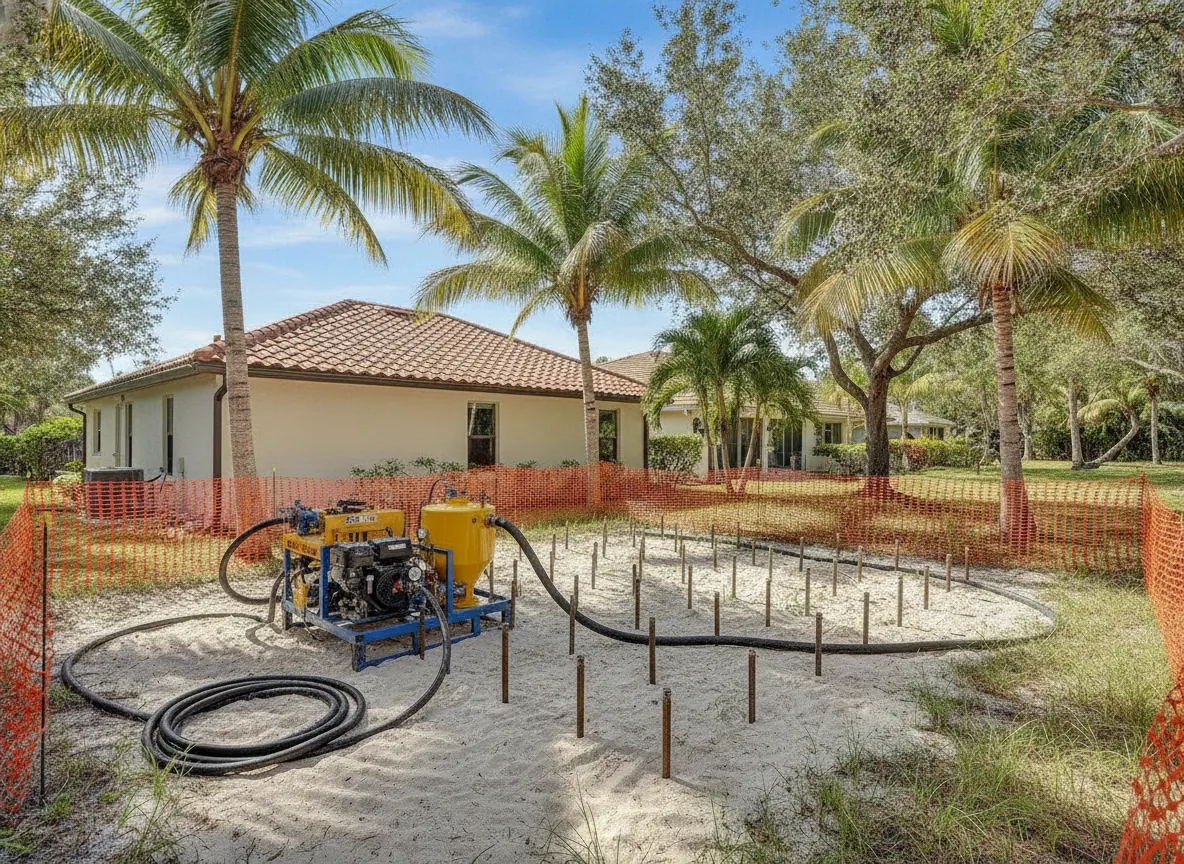
Florida Senate staff, citing the Florida Geological Survey (FGS), list Orange and parts of Lake and Seminole among counties with shallow limestone "overlain by sands with various mixtures of clay." The FGS describes two main kinds of sinkhole in this setting:
The FGS also lists look-alikes that cause ground subsidence without any sinkhole: "subsurface expansive clay or organic layers which compress as water is removed, collapsed or broken sewer and drain pipes or broken septic tanks, improperly compacted soil after excavation work, and even buried trash, logs and other debris." That is why testing comes first.
The FGS database caveat: "the majority of the incidents have not been field-checked and the cause of subsidence is not verified."
| County | Reported subsidence incidents |
|---|---|
| Orange | 232 |
| Lake | 178 |
| Seminole | 172 |
| Osceola | 16 |
These counts are reports, not confirmed sinkholes,, and per-place counts are approximate. Orange County accounted for 2.2 percent of Florida's 2006–2009 sinkhole insurance claims, while Hernando, Pasco and Hillsborough counties together made up over 66 percent (Florida Senate Interim Report 2011-104). The most widely reported local event is the Winter Park sinkhole of May 8, 1981, which the USGS describes as about 300 feet across with a visible depth of about 80 feet. The FGS lists drought, heavy rainfall and heavy groundwater pumping among triggers, and 2026 has been one of the driest starts on record in Orlando. The settlement vs sinkhole guide covers the difference in more depth.
The FGS says "Licensed home inspectors and insurance adjustors are not trained nor qualified to determine if there is a sinkhole," and "The expertise of a licensed professional engineer is required to determine if a structure is structurally safe." It also notes that no agency inspects sinkholes for homeowners: "there is no agency with responsibility or authority for sinkhole inspections in Florida."
A Florida-licensed professional engineer (PE) or professional geologist investigates the site, and a PE recommends the stabilization method. Diagnosing the cause is engineering under chapter 471; a contractor may install the PE-designed repair (§471.003(2)(f)). A contractor's free evaluation is a sales estimate, not an engineering opinion. The foundation and sinkhole inspection page explains what those reports cover.
For a new hole in the yard, FGS advice starts with "Mark and secure the hole" and "Do not put water into the hole." The FGS Sinkhole Helpline is 850-245-2118.
The engineer's design sets the method and depth.
A stiff cement-based grout is pumped through pipes driven into the ground, often down toward the limestone, to fill voids and densify loose, raveling soil beneath and around the house.
Polyurethane or similar chemical grout is injected at shallower depths to bind loose sand and fill small voids just under the foundation.
Steel piers are installed under the foundation to carry the house's weight down to a deeper, firmer layer. See house leveling and piers.
Angi puts typical residential sinkhole repair at $10,000–$20,000 in most cases (a typical national range, an estimate, not a quote); actual costs come from the PE's design. See the grouting vs piers comparison.
Every Florida property insurer must cover catastrophic ground cover collapse, which requires an abrupt collapse, a visible depression, structural damage and the home being condemned and ordered vacated; "settling or cracking of a foundation" alone is not a catastrophic ground cover collapse (§627.706(2)(a)). Broader "sinkhole loss" coverage is optional for an added premium (§627.706(1)(b)). Notice of a sinkhole claim is barred after 2 years (§627.706(5)).
Insurers must have a PE or professional geologist test when sinkhole loss is suspected (§627.7072). Repairs on a covered sinkhole loss must follow the insurer's engineer's recommendations, and the insurer may limit payment to actual cash value (excluding underpinning or grouting) until the policyholder contracts for stabilization (§627.707(5)); neutral evaluation is available (§627.7074). Sellers must disclose a paid sinkhole claim and whether the proceeds were used for repairs (§627.7073(2)(c)). Ask your insurer what your policy covers. This is general information, not legal or insurance advice. The sinkhole insurance law explainer quotes the statutes in full.
In Florida, structural foundation repair, underpinning and sinkhole stabilization of a house is Division I contracting: a certified or registered general contractor (CGC/RGC) or residential contractor (CRC/RRC) clearly qualifies, and a building contractor (CBC) arguably does for homes up to three stories (Fla. Stat. §489.105(3)(a)–(c)); Florida has no separate foundation or underpinning specialty license. A contractor's license number must appear in its ads and contracts (§489.119(5)(b)). Check it on MyFloridaLicense.com, and remember that a county business tax receipt is not a license. Unlicensed contracts are unenforceable by the contractor (§489.128). The Florida Homeowners' Construction Recovery Fund covers Division I contracts signed on or after July 1, 2024 up to $100,000, only for licensed contractors. The handyman exemption (under $2,500) does not fit foundation work.
Permits: Orange County says structural repairs to foundations need a permit, construction plans are required in most cases, and plans must be signed and sealed by a Florida PE or registered architect when repairs affect structural stability; a Notice of Commencement is required when work exceeds $5,000 (Orange County permit pages). In Seminole, Osceola and Lake counties and the cities, permit rules vary; the licensed contractor confirms and pulls any permit.
We connect Orlando-area homeowners with independent Florida-licensed contractors for free, no-obligation foundation repair quotes. The contractor you choose quotes, contracts and does the work. Start with the free quote form; we usually reply the same day.
Yes, but the numbers need context. The Florida Geological Survey lists 232 reported subsidence incidents in Orange County as of Oct 19, 2026, most never field-checked, so they are reports, not confirmed sinkholes. Orange was 2.2 percent of Florida's 2006–2009 sinkhole insurance claims, while Hernando, Pasco and Hillsborough made up over 66 percent (Florida Senate Interim Report 2011-104).
After a professional engineer or geologist investigates, a PE designs the repair. Common methods are compaction grouting, which pumps cement grout deep to fill voids and densify loose soil; chemical grouting, which binds shallow sand under the foundation; and underpinning with steel piers to a firmer layer. Many plans combine methods. A Division I contractor installs the PE-designed repair.
The Florida Geological Survey says cover-subsidence sinkholes form where thick permeable sediments cover the limestone, so sand ravels down and the ground sags gradually. Cover-collapse sinkholes occur where sediments overlying a void in the rock suddenly collapse, usually where clay holds the cover together until it fails. Only testing by a PE or professional geologist can tell what is happening at a home.
Not by itself. Under §627.706(2)(a), catastrophic ground cover collapse requires an abrupt collapse, a visible depression, structural damage and the home being condemned and ordered vacated, and settling or cracking of a foundation alone does not qualify. Broader sinkhole loss coverage is optional. Ask your insurer what your policy covers. This is general information, not legal or insurance advice.
No government agency does. The Florida Geological Survey says there is no agency with responsibility or authority for sinkhole inspections in Florida, and that home inspectors and adjusters are not qualified to determine if there is a sinkhole. A Florida-licensed professional engineer or professional geologist investigates, and when sinkhole loss is suspected, an insurer must have one test (§627.7072).
Free, no-pressure quotes across Orlando, Winter Park, Kissimmee, Sanford, Altamonte Springs and Central Florida.