House Leveling & Piers in Orlando, FL

Floors sloping or cracks that keep coming back? Here is how push piers, helical piers and foam lifting are used to level settling homes on Central Florida sand, and how to compare free quotes.

Get a Free Quote Call (727) 300-6656
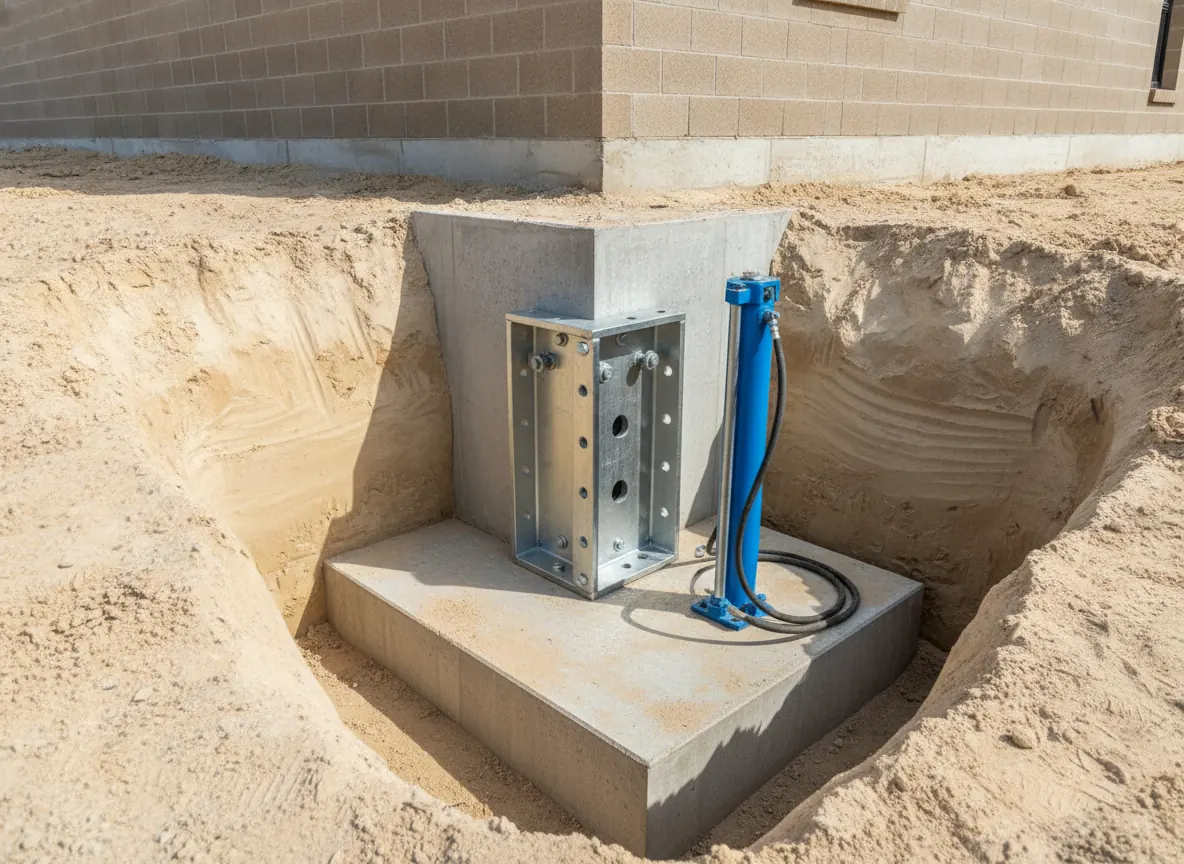
Steel pier bracket on a footing in a sandy excavation

When a house needs leveling or piers

House leveling and underpinning come up when part of a home keeps settling: floors slope, cracks reopen after being patched, doors and windows keep binding, or an engineer finds that the soil under a footing or slab edge cannot carry the load. In Central Florida that soil is usually sand, and USDA NRCS data shows it has negligible shrink-swell, so the usual culprits are compressing organic muck, poorly compacted fill and loose sand, not swelling clay. Piers bypass that weak layer and carry the house down to firmer soil below.

Depth to good bearing soil varies a great deal across the region. Florida Senate staff, citing the Florida Geological Survey, describe Orange and parts of Lake and Seminole counties as having shallow limestone overlain by sands with various mixtures of clay, but no source gives a depth for any particular neighborhood. That is why pier depth is measured during installation, not promised in advance.

Push piers, helical piers and foam lifting

These are the main methods contractors quote for leveling a slab home. An engineer's design decides which fits.

Steel push piers

Steel pipe sections are driven hydraulically beside the footing, using the weight of the house as resistance, until they reach refusal on firm soil. A bracket then transfers the load to the pier, and the house can be lifted back toward level. Push piers suit heavier loads such as block walls on a footing.

Helical piers

A steel shaft with helix plates is screwed into the ground with a torque motor. The installation torque is used to estimate capacity, and because helicals do not rely on the house's weight to drive them, they suit lighter structures, porches and slab sections.

Foam lifting

Where the problem is a shallow void under part of the slab rather than deep settlement, expanding polyurethane foam injected through small holes can fill the void and lift the concrete. It does not reach deeper weak soils. See slab foundation repair.

Shimming older homes on piers

Some older homes sit on raised floor framing over masonry piers instead of a slab. Leveling these usually means jacking the floor framing and adding or replacing shims and supports, and sometimes adding new piers where an original one has settled. Repairs to framing and supports are still structural work, so the same license and permit rules apply.

Load testing, the PE design and the final letter

  1. Engineer's evaluation and design

    Diagnosing why the house moved is engineering under chapter 471, which only a Florida-licensed professional engineer (PE) may do. The PE specifies the pier type, spacing and target capacity; a contractor may install a PE-designed repair (§471.003(2)(f)). A contractor's free evaluation is a sales estimate, not an engineering opinion.

  2. Permit and plans

    Orange County says structural repairs to foundations need a permit, construction plans are required in most cases, and plans must be signed and sealed by a Florida PE or registered architect when repairs affect structural stability; a Notice of Commencement is required when work exceeds $5,000 (Orange County permit pages). In Seminole, Osceola and Lake counties and the cities, permit rules vary; the licensed contractor confirms and pulls any permit.

  3. Installation and load testing

    Each pier is typically load tested as it is installed: push piers are driven against the structure's weight and helical piers are monitored for torque, and the readings are logged pier by pier. Ask the contractor to share that log, and ask whether the pier system has an ICC-ES evaluation report.

  4. Lift and final letter

    Lifting is done gradually, with elevations checked as the house comes up; not every home can or should return to perfectly level. Ask whether the PE will issue a final letter confirming the work matched the design, and whether your permit needs one; some Florida counties outside this area will not close a stabilization permit until a sealed final report or letter is submitted.

Some homeowners compare piers with grouting on homes where testing finds deeper raveling soils; the sinkhole and subsidence repair page and the grouting vs piers guide cover that choice.

Typical pier and leveling costs

No Orlando contractor publishes prices. The number of piers comes from the engineer's design, so totals vary widely.

Typical national ranges from This Old House (2026), Bob Vila, HomeGuide (2026) and Angi (2026) — estimates, not quotes.
ItemTypical range
Steel or push pier, installed$1,000–$3,000 each
Helical pier, installed$2,000–$4,000 each
Polyurethane foam liftingabout $5–$25 per sq ft (minimum job roughly $300–$700)
Settling or sinking foundation$4,500–$20,000; severe sinking $15,000–$40,000
Foundation lifting / leveling (major)$20,000–$23,000
Structural engineer's reportabout $340–$1,000 (up to $3,000 for complex cases)

The foundation repair cost guide breaks down what moves these numbers.

Who can install piers in Florida

In Florida, structural foundation repair, underpinning and sinkhole stabilization of a house is Division I contracting: a certified or registered general contractor (CGC/RGC) or residential contractor (CRC/RRC) clearly qualifies, and a building contractor (CBC) arguably does for homes up to three stories (Fla. Stat. §489.105(3)(a)–(c)); Florida has no separate foundation or underpinning specialty license. A contractor's license number must appear in its ads and contracts (§489.119(5)(b)); check it on MyFloridaLicense.com, and remember that a county business tax receipt is not a license. The handyman exemption (under $2,500) does not fit foundation work.

If you live in a community association, visible pier work along the outside of the house may need architectural review. Florida's §720.3035 limits that review to what the declaration states, so check your declaration.

We connect Orlando-area homeowners with independent Florida-licensed contractors for free, no-obligation foundation repair quotes. The contractor you choose quotes, contracts and does the work. Describe the problem on the free quote form; we usually reply the same day. The process page shows what happens next.

House Leveling & Piers FAQ

What is the difference between push piers and helical piers?

Push piers are steel pipe sections driven hydraulically beside the footing, using the house's weight as resistance, until they reach firm soil. Helical piers are steel shafts with helix plates screwed into the ground, with torque used to estimate capacity, so they suit lighter loads. National guides put push piers at $1,000–$3,000 each and helical piers at $2,000–$4,000 each, installed.

How many piers does a house need?

It depends on how much of the house is settling, the weight of the walls, and the capacity each pier reaches in the soil below. A Florida-licensed professional engineer sets the number and spacing in the repair design; a contractor's estimate before that design is a sales figure. Ask any contractor quoting piers whether the count comes from an engineer's plan.

Can a house be lifted back to perfectly level?

Not always. Leveling is done gradually while elevations are checked, and the engineer and contractor may stop short of full recovery if lifting further would stress walls, finishes or under-slab plumbing. The goal of piering is to stop further settlement and recover what the structure can tolerate. Ask the contractor what lift they expect and how it will be measured.

Does pier work need a permit and engineer in Orange County?

Orange County says structural repairs to foundations need a permit, plans are required in most cases, and plans must be signed and sealed by a Florida PE or registered architect when repairs affect structural stability; a Notice of Commencement is required over $5,000. Elsewhere, rules vary and the licensed contractor confirms and pulls any permit.

How much does house leveling cost in Central Florida?

No Orlando contractor publishes prices. National guides put settling or sinking foundation repair at $4,500–$20,000, severe sinking at $15,000–$40,000 and major lifting or leveling at $20,000–$23,000. These are typical national estimates, not quotes. The pier count in the engineer's design drives most of the cost for a specific home.

Cracked slab, sticking doors or a new depression in the yard? Get a clear quote.

Free, no-pressure quotes across Orlando, Winter Park, Kissimmee, Sanford, Altamonte Springs and Central Florida.

Call NowFree Quote